“I Am a Small Company. I Will Not Be Attacked or Become a Victim of Ransomware.”
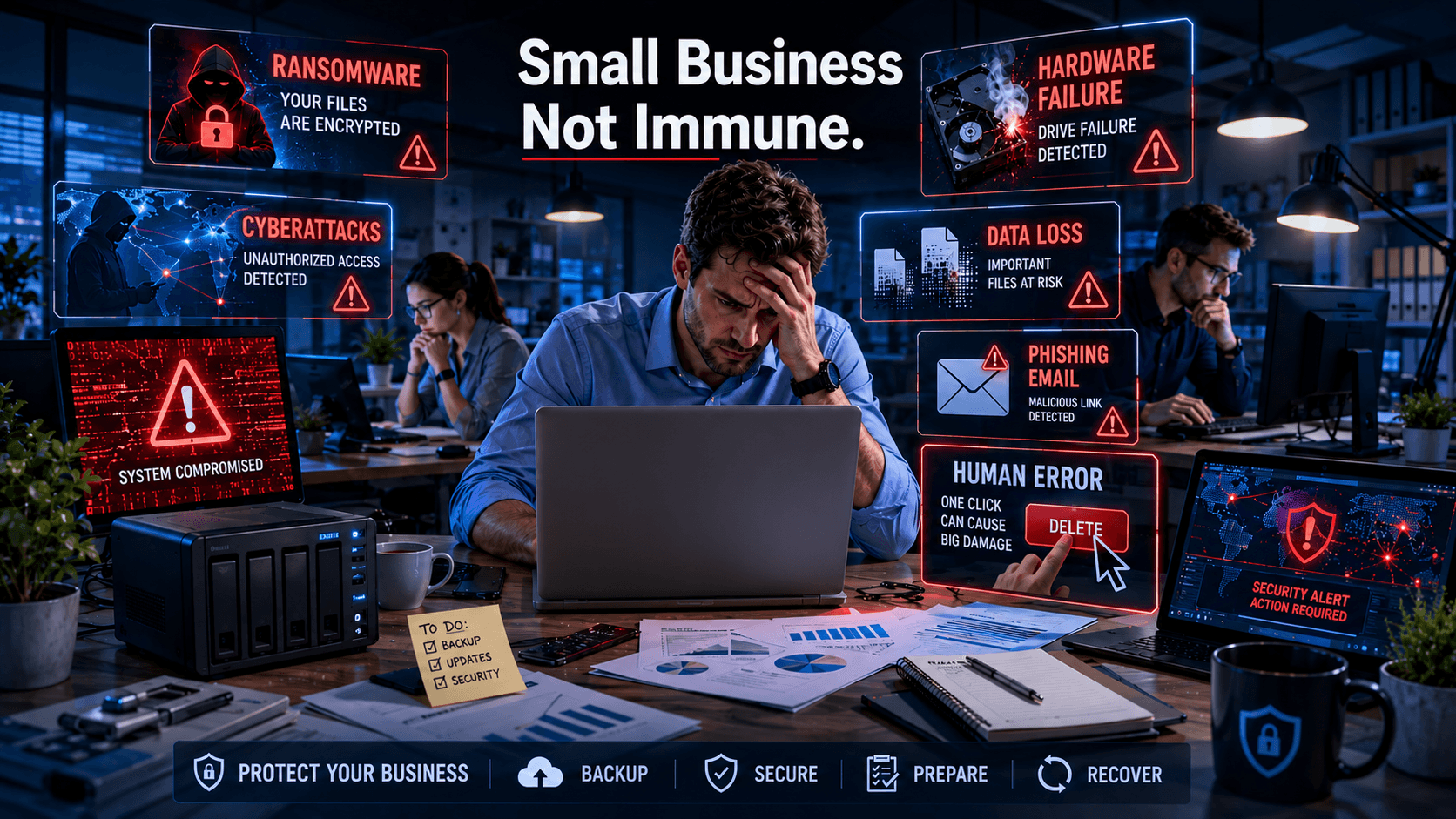
Many small business owners believe cybercriminals only target large corporations, government agencies, or multinational companies. The assumption is understandable: why would hackers spend time attacking a company with only a handful of employees?
Unfortunately, ransomware attacks do not work that way.
Today’s cybercriminals often use automated tools that scan the internet for vulnerable systems, weak passwords, outdated software, exposed remote access services, and unprotected backups. They are not always looking for a specific target—they are looking for easy targets.
In many cases, small businesses are actually more attractive victims because they typically have fewer cybersecurity resources, limited IT support, and less sophisticated defenses.
Why People Believe This
Many business owners assume:
- Their company is too small to be noticed.
- They do not store valuable information.
- Hackers only want large ransom payments.
- Cyberattacks only happen to banks, hospitals, or large enterprises.
These assumptions create a false sense of security that can leave a business exposed.
The Reality
A ransomware attack can affect virtually any organization that uses computers, servers, cloud services, or connected devices.
Cybercriminals understand that small businesses often cannot afford prolonged downtime. If accounting records, customer databases, inventory systems, project files, or operational documents become inaccessible, the pressure to restore operations quickly can be immense.
For many businesses, even a few days of downtime can result in:
- Lost revenue
- Lost productivity
- Missed deadlines
- Damage to reputation
- Loss of customer trust
- Potential legal or regulatory issues
In some cases, the ransom itself is only a small portion of the total financial damage.
Real-World Scenario
Consider a small company with ten employees.
An employee receives an email that appears to be an invoice from a supplier. The attachment is opened, and malware silently installs itself. Overnight, the ransomware spreads across shared folders and encrypts years of business records.
The next morning, every workstation displays the same message:
“Your files have been encrypted. Pay to recover your data.”
The business is forced to halt operations while determining what data can be recovered and whether usable backups exist.
This scenario occurs far more frequently than many business owners realize.
The Truth
- Small businesses are targeted every day.
- Most ransomware attacks are automated and opportunistic.
- A single infected device can affect an entire organization.
- Downtime often costs more than the ransom demand itself.
- Attackers often seek the easiest victims, not necessarily the largest.
What You Should Do Instead
To reduce the risk of ransomware:
- Maintain regular backups using the 3-2-1 backup strategy.
- Keep operating systems and software updated.
- Enable multi-factor authentication whenever possible.
- Train employees to recognize phishing emails.
- Restrict unnecessary administrative privileges.
- Regularly test backup and recovery procedures.
- Develop an incident response plan before an attack occurs.
Final Verdict
“I Am a Small Company. I Will Not Be Attacked or Become a Victim of Ransomware.”
❌ DELUSION
Cybercriminals do not care how large your company is. They care whether your systems are vulnerable and whether you can be pressured into paying. The belief that small businesses are too insignificant to be targeted is one of the most dangerous cybersecurity myths today. Preparation, not company size, is what determines resilience against ransomware.